
Euroclear and Societe Generale Test Stablecoin Settlement for Tokenised Commercial Paper

Updated: Oct 7
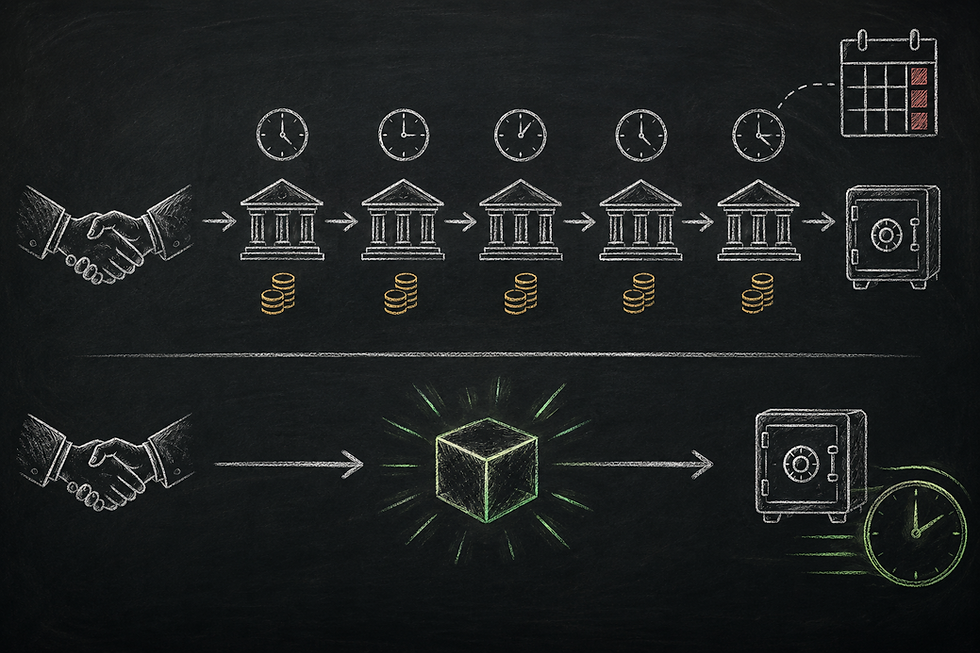
Settlement is the least glamorous word in finance and quite possibly the most important. It is the moment a trade actually completes, when cash and asset change hands and the deal becomes real. For decades that moment has taken days, propped up by a chain of intermediaries each taking a cut and adding a delay. So when one of the institutions that sits at the centre of that machine starts testing a faster way to do it, founders and investors watching the tokenisation story should pay attention, even if the instrument involved sounds obscure.
On 25 June, Euroclear, one of the world's largest settlement houses, and SG-FORGE, the digital assets arm of Societe Generale, said they would explore using a regulated stablecoin to settle tokenised short term debt. The test will use USD CoinVertible, SG-FORGE's MiCA compliant US dollar stablecoin, to settle tokenised, dollar denominated Negotiable European Commercial Paper. Euroclear will act as the core settlement infrastructure for the pilot.
What is actually being tested
Strip away the jargon and the idea is simple. Commercial paper is short term IOU style debt that companies issue to raise cash quickly. Today, a European issuer wanting dollar funding through this market navigates a slow, multi step settlement process. The pilot puts the debt itself on a digital ledger as a token, and puts the cash leg on the ledger too, in the form of a regulated dollar stablecoin. When the two are matched, settlement can happen close to instantly, with the payment and the asset moving together rather than chasing each other across separate systems.
The attraction for issuers is practical. Dollar funding is often cheaper or deeper than euro funding, and a digital cash settlement model makes reaching dollar investors faster and less operationally heavy. The pilot sits alongside Project Pythagore, a parallel effort to move euro denominated commercial paper onto distributed ledger technology with settlement in central bank money.
Why it matters beyond the back office
The headline names are wholesale institutions and the instrument is one most founders will never touch. The significance is in the pattern. The hardest part of tokenisation was never minting a token to represent an asset. It was building settlement plumbing that regulated institutions trust enough to run real money through. Each pilot like this one normalises the idea that a regulated stablecoin is acceptable settlement cash, and that a tokenised security can settle against it within an established market infrastructure rather than an experimental sandbox.
That foundation is the same one private and startup equity will eventually run on. The rails being laid for tokenised commercial paper, with atomic settlement and regulated digital cash, are the rails that make tokenised shares, secondary liquidity and faster capital formation realistic later. It is also notable that SG-FORGE is using a MiCA compliant stablecoin, anchoring the experiment inside Europe's regulatory perimeter rather than outside it, which is precisely what gives conservative institutions the confidence to take part.
For the UK, the read across is clear. As the FCA and Bank of England work through their Digital Securities Sandbox and their joint vision for tokenised wholesale markets, the question of what counts as acceptable settlement cash, and how tokenised assets settle against it, is moving from theory to live testing on the continent. The infrastructure decisions being made now will shape how quickly tokenised equity becomes a practical option for British companies.
Key takeaways
Euroclear and SG-FORGE will test settling tokenised, dollar denominated commercial paper using USD CoinVertible, a MiCA compliant dollar stablecoin, with Euroclear as the settlement infrastructure.
The pilot puts both the debt and the cash on a ledger, enabling near instant settlement where payment and asset move together.
The real significance is institutional trust in settlement plumbing, the hardest and most decisive part of tokenisation, not the tokens themselves.
The same rails being proven for tokenised debt are the foundation that tokenised equity and private market liquidity will eventually depend on.
Sources: Ledger Insights; Asset Servicing Times; Global Custodian; PostTrade360.
How we got here
The dollar test builds on a euro project. On 10 October 2025 the Banque de France and Euroclear announced Project Pythagore to tokenise Negotiable European Commercial Paper. According to the Banque de France, NEU CP is the largest short-term euro debt market in the EU, with €310 billion outstanding. Tokenised euro paper is designed to settle in wholesale central bank money through Pontes, the Eurosystem service that links DLT platforms to TARGET services.
Euroclear's 25 June 2026 release presents the SG-FORGE work as a complement to Pythagore. It explores settlement in currencies other than the euro, starting with US dollars, so that dollar-denominated paper issued in the same French market can settle against a MiCA-compliant digital dollar rather than through correspondent banks.
What happens next
The euro side has moved since June. The ECB launched Pontes on 21 September 2026, with Societe Generale among its initial participants, and expects full implementation by 2028. Under the Pythagore timeline, the first tokenised NEU CP issues are targeted for production by the end of 2026, followed by a ramp-up and automation phase in 2027 and migration of the market to Euroclear's new infrastructure by 2028.
The dollar pilot has no published timetable. Euroclear and SG-FORGE have not named the blockchain they will use or set a date for a first live issue, so those are the details to watch.
What it means for UK founders
The UK is working on the same settlement question by a different route. Tokenised securities trading here runs through the Digital Securities Sandbox rather than a central bank link such as Pontes. Sterling stablecoins that reach systemic scale fall under the Bank of England, which published its policy statement on systemic sterling stablecoins on 22 June 2026, and the FCA cryptoasset regime comes into force on 25 October 2027.
For founders, the practical signal is that euro and dollar settlement options for tokenised instruments are being built inside established European market infrastructure. Startups building issuance, custody or treasury tools that may serve EU clients will need to account for both MiCA-regulated stablecoins and central bank money routes. Founders may want to take professional advice on which settlement assets their products can accept in each market.
Key facts at a glance
10 October 2025: Banque de France and Euroclear announce Project Pythagore.
€310 billion: NEU CP outstanding, the EU's largest short-term euro debt market.
25 June 2026: Euroclear and SG-FORGE announce the USD CoinVertible settlement exploration.
21 September 2026: the ECB launches Pontes, linking DLT platforms to TARGET services.
End of 2026: target for the first tokenised NEU CP issues in production.
2028: expected migration of the NEU CP market to Euroclear's new infrastructure.
Further reading
Frequently asked questions
What are Euroclear and Societe Generale testing with stablecoins?
On 25 June, Euroclear and SG-FORGE, the digital assets arm of Societe Generale, said they would explore using a regulated stablecoin to settle tokenised, dollar denominated Negotiable European Commercial Paper. Euroclear will act as the core settlement infrastructure for the pilot.
What is USD CoinVertible?
USD CoinVertible is SG-FORGE's MiCA compliant US dollar stablecoin. It is the settlement cash being used in the Euroclear pilot for tokenised commercial paper.
How does stablecoin settlement of tokenised commercial paper work?
The debt is placed on a digital ledger as a token and the cash leg is placed on the same ledger as a regulated dollar stablecoin. When the two are matched, settlement can happen close to instantly, with payment and asset moving together rather than across separate systems.
What is Project Pythagore?
Project Pythagore is a parallel effort to move euro denominated commercial paper onto distributed ledger technology, with settlement in central bank money.

Comments