
Ondo's Tokenised Stock Platform Passes $1bn in Under Eight Months
- Shawn Jhanji
- Jun 23
- 3 min read

The rails now reaching mainstream wallets are the same rails private and startup equity will eventually run on.
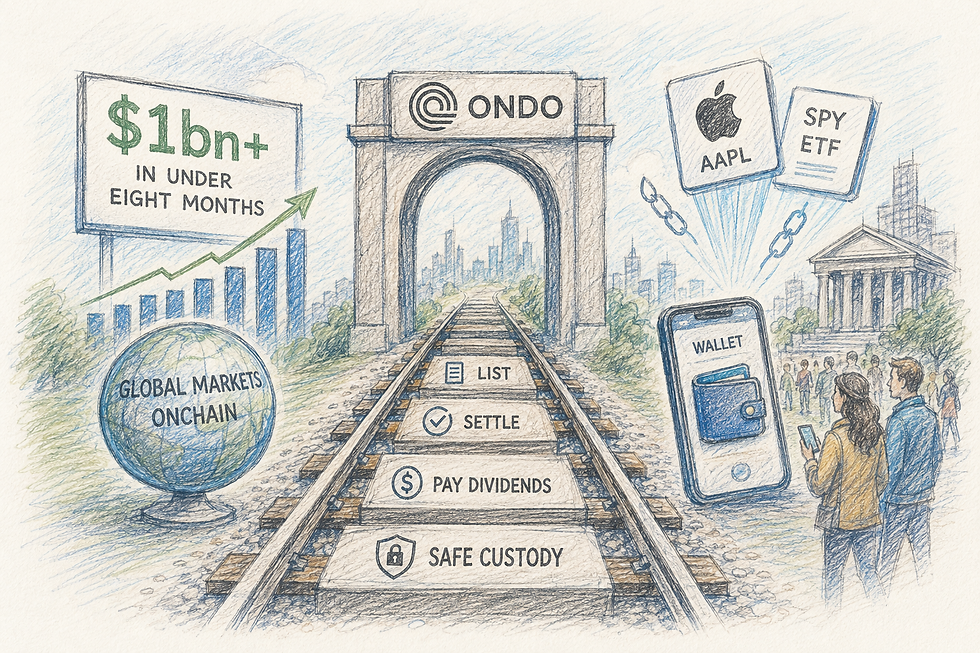
A tokenised version of an Apple share is not, on its own, a story that should keep a UK founder awake. What should hold their attention is the plumbing being built to carry it. The infrastructure that can list public stocks onchain, settle them, pay their dividends and hold them safely is the same infrastructure that private company equity, including startup equity, will one day depend on. And that plumbing is suddenly being laid at speed.
Ondo Finance said this month that its Global Markets platform has passed $1bn in total value locked across tokenised stocks and exchange traded funds. It claims to be the first tokenised equity platform to reach that mark, and it did so in under eight months. Growth at that pace tells you the demand was waiting for the product, not the other way round.
The distribution is moving just as quickly. On 12 June the self-custody wallet company Exodus switched on Exodus Markets in partnership with Ondo, putting more than 200 tokenised stocks, ETFs and real world assets on the Solana network inside its app for eligible users in selected markets. Tokenised equities are also reachable through mainstream wallets such as MetaMask for users in supported regions outside the United States. The pattern is clear. These assets are leaving the specialist venues and arriving where ordinary investors already keep their money.
The incumbents are not standing still. On 16 June Coinbase set out plans to issue tokenised stocks backed one for one by the underlying shares, with dividends paid automatically onchain. Days earlier, Citi went live with Digital Depositary Receipts that put tokenised interests in private companies in front of its wealth and institutional clients, and projected the tokenised securities market could reach $5.5tn by 2030. A wallet app, a crypto exchange and a global custody bank are now building versions of the same idea at the same time.
That rarely happens by accident.
Here is why this matters beyond the trading screen. Most of the early volume is in public equities because they are liquid, priced and easy to reference. But the hard problems being solved along the way, custody of a tokenised security, automatic distribution of income, compliant transfer between holders, are exactly the problems that stand between a private company and a tokenised cap table. Solve them for Tesla stock and you are a long way towards solving them for a Series B software company in Leeds that wants to let early employees and angels realise some value without waiting years for a trade sale.
None of this is an argument for throwing private markets open to every retail buyer, and that is a separate debate the sector should be careful not to fold into this one. The founder question is narrower and more useful. Can a company reach the right qualified investors more directly, manage its register with less friction, and offer early backers a route to liquidity that does not require surrendering control?
The infrastructure now reaching mainstream wallets is a real step towards yes.
The gap, for a UK reader, is access and perimeter. Much of this activity is live in the United States and a handful of non-US markets, shaped by where the rules are clearest. Britain has the Digital Securities Sandbox and a serious tokenisation agenda, but the consumer-facing edge of tokenised equity is largely happening elsewhere for now. The direction of travel is not in doubt. The open question is how quickly the UK turns its regulatory groundwork into products that founders and investors can actually use.
Key Takeaways
Ondo's Global Markets platform has passed $1bn in total value locked across tokenised stocks and ETFs, which it says makes it the first tokenised equity platform to do so, in under eight months.
Exodus launched tokenised trading of more than 200 stocks, ETFs and real world assets on Solana with Ondo on 12 June, and the assets are reaching mainstream wallets such as MetaMask in supported regions.
Coinbase and Citi are building competing tokenised equity products, with Citi projecting a $5.5tn tokenised securities market by 2030.
The custody, settlement and income mechanics being solved for public stocks are the same ones tokenised private and startup equity will rely on, which is why founders should track this closely.
Sources



Comments