
RWA Tokenisation Gets Its First Common Standard. Game changer?

Updated: Oct 7
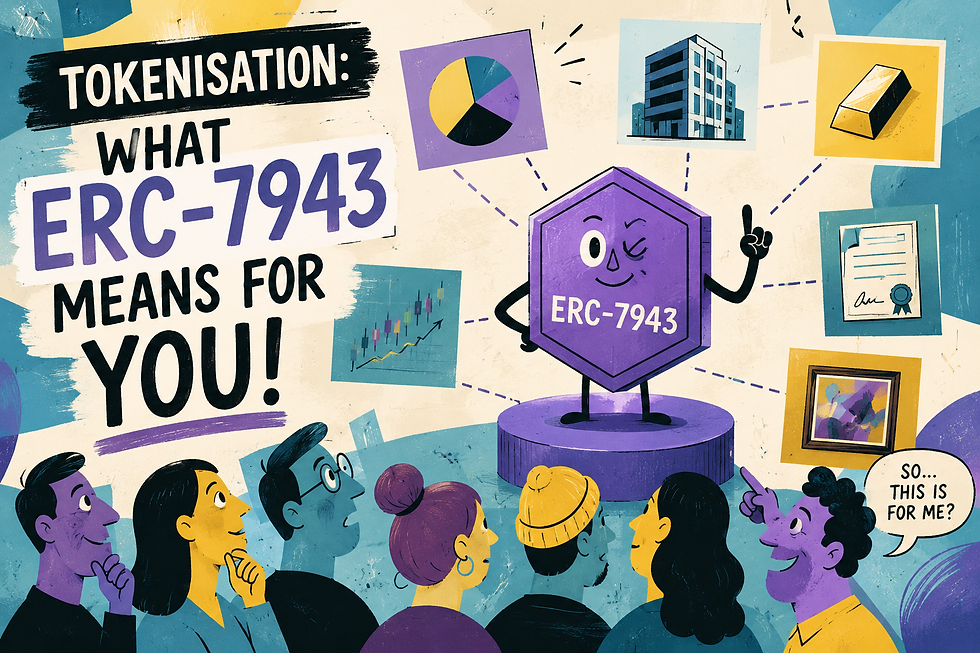
For most of its short history, tokenisation has had a quiet structural problem. It has been discussed extensively for some time, with no real solution. Until now.
To date, almost every legacy platform that issues a tokenised bond, fund or slice of private equity has tended to build its own rules for how that token behaves: how a transfer might be checked against a whitelist, how an asset is frozen when a court orders it, how a regulator forces a transfer when something goes wrong. The result is the market we have currently: one of clever but incompatible silos.
A token issued on one platform cannot easily move to another, and an institution that wants to hold tokenised assets from several providers has had to integrate with each one separately. When it comes to portability, it's also not ideal if you are the owner or issuer of the tokens and you want to change platforms, or move elsewhere.
That is the gap a new Ethereum standard is trying to close. ERC-7943 reached Final status on 27 May 2026, the point at which an Ethereum standard stops being a proposal and becomes a settled reference that anyone can build against.
It defines a minimal, vendor neutral interface for compliant real world asset tokens, covering the four operations that institutional issuers cannot do without: validating whether a transfer is allowed, freezing assets, executing forced transfers, and supporting enforcement actions. Significantly, it does this without locking issuers into a particular identity provider, jurisdiction or compliance stack.
Does a shared interface matter?
The significance is less about the technology and more about what standardisation does to a young market. When every issuer speaks a slightly different dialect, custodians, exchanges and auditors have to do bespoke work for each one. That cost is invisible to outsiders but it is one of the real reasons institutional tokenisation has moved more slowly than the headline numbers suggest. A common interface means a custodian can support compliant tokens from many platforms with one integration, an exchange can list them without renegotiating the plumbing each time, and an auditor can check them against a known specification rather than a private design.
The standard is deliberately thin. It does not tell an issuer which Know Your Customer provider to use or which country's rules apply. It only fixes the points where tokens need to interoperate, leaving the commercial and jurisdictional choices to the issuer. That restraint is the point. A standard that tried to dictate the whole compliance stack would have been rejected by firms that have built their businesses around particular jurisdictions. By standardising only the interface, ERC-7943 lets competitors agree on the shared rails while still competing on everything above them.
A coalition, not a single vendor
What gives the standard credibility is the breadth of the group behind it. The coalition first announced in September 2025 has since grown to span the full RWA stack: issuance platforms including Brickken and DigiShares, infrastructure and security firms such as Hacken, identity and tooling providers, exchanges and marketplaces including RealEstate.Exchange, and names such as Bit2me, Compellio, Dekalabs, Forte Protocol, Stobox and Zoth.
This pretty heavyweight spread of participants really matters because a standard is only as useful as the number of serious players willing to implement it. A specification backed by one vendor is a product. A specification backed by issuers, infrastructure providers, exchanges and audit firms at once starts to look like an actual standard.
The momentum is visible in the events calendar too. Brickken and DigiShares are co hosting a webinar on 9 June on what ERC-7943 means for issuers, platforms and institutional adoption, a sign that the firms involved now see explaining the standard to the wider and perhaps more mainstream market, as part of the work.
What it means for the UK market
For UK founders, investors and the advisers around them, the immediate effect is not dramatic, but the direction is really worth noting. The UK's own tokenisation framework is advancing through the FCA and Bank of England's joint work on wholesale markets and the fund tokenisation rules published earlier this year. Those efforts set the regulatory perimeter. Standards like ERC-7943 fill in the technical layer underneath, and the two are complementary. A market where the rules are becoming clearer and the technical interfaces are converging is a market where building becomes cheaper and integration risk falls.
A fair caveat is that a Final standard at this time, is in reality, a starting line and not a finish. Adoption is what turns a specification into infrastructure, and that will be measured over the next year in how many live issuances actually implement it and how many custodians and exchanges support it by default.
'Standards' have failed before by being technically sound and commercially ignored but appearances indicate that the composition of this current coalition, and the fact that direct competitors agreed to a shared interface at all, suggests the market has reached the stage where fragmentation costs more than cooperation. That to my mind, more than any single feature, is the real news.
Key Takeaways
ERC-7943 reached Final status on 27 May 2026, giving institutional RWA tokenisation its first common, vendor neutral interface on Ethereum.
The standard fixes only the points where tokens must interoperate (transfer validation, freezing, forced transfers, enforcement), leaving identity and jurisdiction to the issuer.
A broad coalition spanning issuers, infrastructure, exchanges and audit firms backs it, including Brickken, DigiShares, Stobox, Hacken and others.
Standardisation should lower integration cost for custodians, exchanges and auditors, which is one of the real brakes on institutional adoption.
Adoption, not Final status, is the test that matters now, and it will play out over the next year.
Sources:
ERC-7943 Achieves Final Status as Ethereum's Standard for Real-World Asset Tokenization, GlobeNewswire, 27 May 2026: https://www.globenewswire.com/news-release/2026/05/27/3301737/0/en/erc-7943-achieves-final-status-as-ethereum-s-standard-for-real-world-asset-tokenization.html
ERC-7943 Standard Unites RWA Platforms For Institutional Tokenization, FinanceFeeds: https://financefeeds.com/erc-7943-standard-unites-rwa-platforms-for-institutional-tokenization/
ERC-7943: A New Tokenization Standard for Real-World Assets, Brickken: https://www.brickken.com/post/erc-7943-tokenization-standard
Frequently asked questions
What is ERC-7943?
ERC-7943 is an Ethereum standard that defines a minimal, vendor neutral interface for compliant real world asset tokens. It reached Final status on 27 May 2026.
What operations does the ERC-7943 standard cover?
It covers four operations institutional issuers need: validating whether a transfer is allowed, freezing assets, executing forced transfers and supporting enforcement actions. It leaves the choice of identity provider, jurisdiction and compliance stack to the issuer.
Who supports the ERC-7943 tokenisation standard?
A coalition first announced in September 2025 backs it, including issuance platforms Brickken and DigiShares, security firm Hacken, RealEstate.Exchange, and firms such as Bit2me, Compellio, Dekalabs, Forte Protocol, Stobox and Zoth.
Why does a common standard matter for real world asset tokenisation?
Without one, custodians, exchanges and auditors must do bespoke work for each platform. A shared interface lets them support compliant tokens from many platforms with one integration, though adoption over the coming year is the real test.


Comments