
Six Weeks Left to Shape UK Crypto Rules: Why the FCA's Perimeter Guidance Consultation Matters for Every Tokenisation Business

Updated: Oct 7
For any business building in the UK digital assets space, a consultation paper published by the FCA in late April carries unusually high practical stakes. CP26/13, the FCA's consultation on cryptoasset perimeter guidance, closes on 3 June 2026. What it decides will determine which businesses need FCA authorisation under the new regime and which do not. The window to respond is closing.
What CP26/13 is about
The Financial Services and Markets Act 2000 (Cryptoassets) Regulations 2026, enacted in February 2026, brought a new set of regulated activities for cryptoassets into the FCA's perimeter from October 2027.
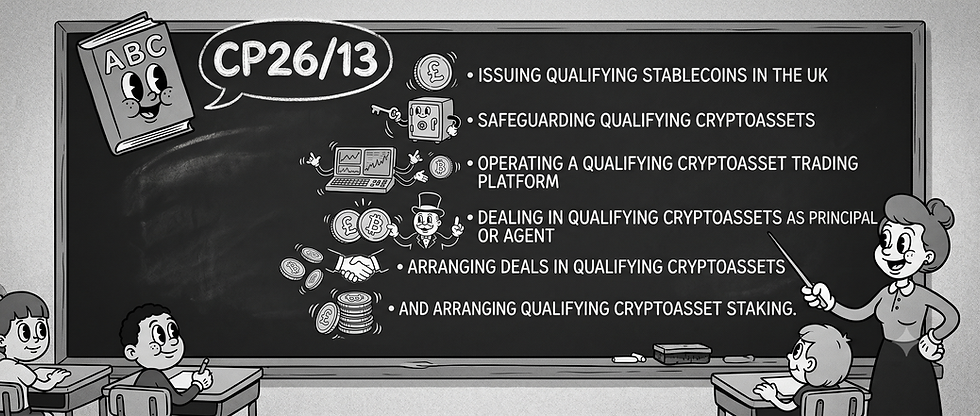
The seven regulated activities covered include:
issuing qualifying stablecoins in the UK
safeguarding qualifying cryptoassets
operating a qualifying cryptoasset trading platform
dealing in qualifying cryptoassets as principal or agent
arranging deals in qualifying cryptoassets
and arranging qualifying cryptoasset staking.
CP26/13 is not about what the rules say. It is about what falls within their scope. The FCA is asking the market to help clarify which activities, products and business models are actually captured by the new regime, and which are not. The final guidance, expected in September 2026, will be the primary reference document for authorisation applications.
Why the answer is not obvious
The perimeter questions for cryptoassets are genuinely complex. Several key distinctions matter enormously to business model viability.
First, tokenised versions of existing regulated investments, including equities, bonds and funds, are excluded from the definition of qualifying cryptoasset under the Regulations. This means tokenised equity platforms, tokenised authorised funds and tokenised debt instruments may be regulated under existing financial services legislation rather than the new cryptoasset regime. Understanding which regime applies is essential before submitting an authorisation application, because the capital requirements, governance obligations and conduct rules differ substantially between the two frameworks.
Second, the boundary between operating a trading platform and providing ancillary services to one is a live question. Whether a business is operating a platform or simply providing software infrastructure to one could determine whether it needs full FCA authorisation under the new regime.
Third, DeFi protocols and Web3 user interfaces present specific and very different perimeter questions that the FCA has explicitly flagged in CP26/13. This directly affects founders building decentralised applications or wallet products with any UK-facing dimension. The FCA is not yet providing definitive answers on these, which is precisely why the consultation matters.
Travers Smith has noted that almost immediately after CP26/13 was published, further legislative changes were made to the regulatory perimeter, adding a further layer of complexity. Any business that assumed the framework was settled should review the current position with legal counsel.
The September gateway
The practical timeline makes early action important. The FCA application window for cryptoasset authorisation opens on 30 September 2026, running to 28 February 2027. Final perimeter guidance is expected in September. Businesses that need authorisation should be determining that well before September, because applications for complex business models require detailed legal analysis, compliance infrastructure and governance preparation.
The October 2027 commencement date gives firms roughly a year after the gateway opens to achieve authorisation. Operating without authorisation after October 2027 will constitute a criminal offence for firms carrying on regulated cryptoasset activities. The window is not as wide as it may appear.
What this means for founders and platform builders
For UK-based founders building tokenisation infrastructure, platforms or services, the key questions to work through before September are straightforward in principle but complex in practice. Does the activity fall within the seven regulated activities? If it does, is it excluded by the tokenised investment carve-out? If not excluded, what kind of authorisation is required and what are the capital, operational and governance requirements?
Baker McKenzie, Lewis Silkin, Travers Smith and Linklaters have all published accessible analysis on CP26/13. The FCA's consultation paper itself is available at fca.org.uk and is worth reading directly for any business with a UK digital assets dimension.
Firms have until 3 June 2026 to submit written responses to the FCA. Even for businesses not planning to respond formally, the questions the FCA is asking should prompt an internal review of how the new regime applies to their model.
Key Takeaways
The FCA's CP26/13 perimeter guidance consultation closes 3 June 2026 and will shape which UK businesses require cryptoasset authorisation
Seven new regulated activities come into force in October 2027, with the FCA application gateway opening September 2026
Tokenised equities, bonds and funds may fall outside the new cryptoasset regime under the existing regulated investment carve-out
DeFi protocols, Web3 interfaces and wallet providers face specific and unresolved perimeter questions in the current consultation
Legal analysis of business model scope should start now, not in September, to allow time for compliance preparation before the gateway opens
Sources
FCA CP26/13 consultation paper: https://www.fca.org.uk/publications/consultation-papers/cp26-13-cryptoasset-perimeter-guidance
FCA new cryptoasset regime overview: https://www.fca.org.uk/firms/new-regime-cryptoasset-regulation
Baker McKenzie analysis: https://www.bakermckenzie.com/en/insight/publications/2026/05/united-kingdom-fca-and-treasury-consultations-on-cryptoassets-perimeter
Lewis Silkin: https://www.lewissilkin.com/insights/2026/04/28/fca-consults-on-perimeter-guidance-for-cryptoasset-activities-102mr05
Frequently asked questions
What is the FCA's CP26/13 consultation?
CP26/13 is the FCA's consultation on cryptoasset perimeter guidance. It asks the market to help clarify which activities, products and business models fall within the new UK cryptoasset regime, and it closed to written responses on 3 June 2026.
Which cryptoasset activities will the FCA regulate from October 2027?
Under the Financial Services and Markets Act 2000 (Cryptoassets) Regulations 2026, regulated activities include issuing qualifying stablecoins in the UK, safeguarding qualifying cryptoassets, operating a qualifying cryptoasset trading platform, dealing as principal or agent, arranging deals and arranging qualifying cryptoasset staking.
Are tokenised equities, bonds and funds covered by the UK cryptoasset regime?
Tokenised versions of existing regulated investments are excluded from the definition of qualifying cryptoasset. Tokenised equity platforms, authorised funds and debt instruments may therefore be regulated under existing financial services legislation rather than the new cryptoasset regime.
When does the FCA application window for cryptoasset authorisation open?
The FCA application window opens on 30 September 2026 and runs to 28 February 2027, with final perimeter guidance expected in September 2026. Operating without authorisation after October 2027 will be a criminal offence for firms carrying on regulated cryptoasset activities.


Comments