
Two New Reports Are Rating the Tokenisation Platform Market. Here Is What the UK Should Actually Be Looking For.

Updated: Oct 7
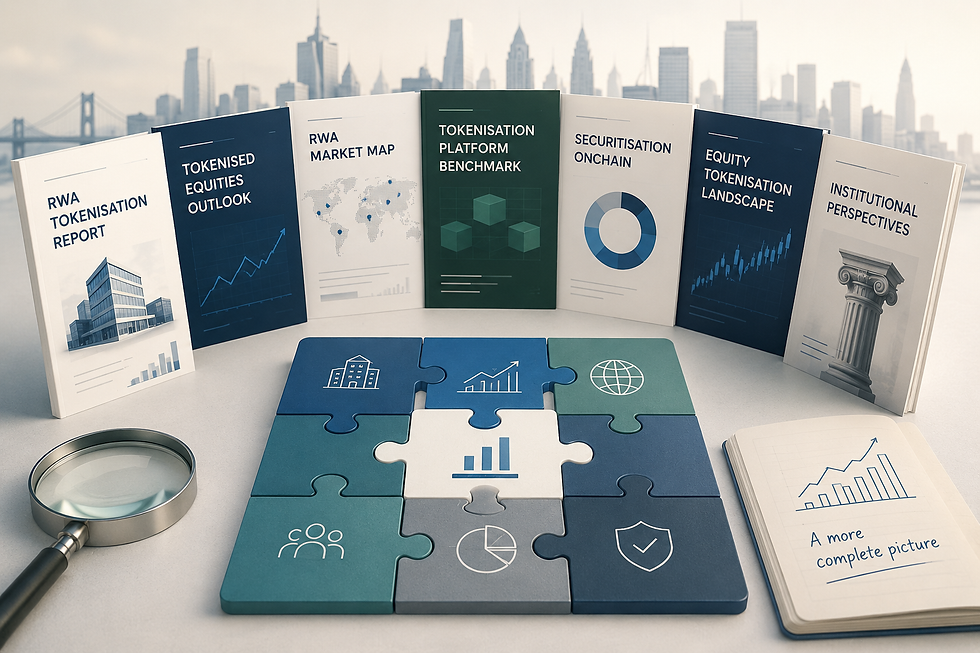
A quiet signal is worth paying attention to. Two independent reports have recently set out to rank and compare the tokenisation platforms now operating across Europe and beyond.
One, published by relative 'new kids on the block' the German firm Onino, focuses specifically on white-label tokenisation platforms operating within the EU under the new MiCA and DLT Pilot Regime frameworks.
The other, published on Medium by the US-based infrastructure firm Zoniqx, takes a broader sweep across the global tokenisation landscape covering platforms active in 2025 and into 2026.
Taken separately, each report gives practitioners a useful view of a fast-moving market. Taken together, they tell a more interesting story: the tokenisation industry has grown up enough to start analysing itself.
What the Onino Guide Covers
The Onino 2026 EU guide identifies seven leading white-label tokenisation platforms:
Bitbond
Brickken
DigiShares
ONINO
Securitize
Stokr
Tokeny.
The methodology prioritises regulated European activity, institutional scale, and white-label capability, which means each platform must be able to power a branded product for a financial institution or operator rather than issuing tokens only under its own name.
By that measure, Tokeny stands at the top. The firm leads on institutional scale with more than $32 billion tokenised across its T-REX and ERC-3643 network, and its protocol has become a reference standard for regulated securities issuance on Ethereum. Securitize Europe holds a distinction none of its peers can match: it is the only firm holding a CNMV-authorised DLT Trading and Settlement System licence under the EU DLT Pilot Regime, meaning it is one of the very few platforms in Europe licensed to operate both primary issuance and secondary trading in a regulated environment.
Stokr and DigiShares have each crossed $1 billion in tokenised assets, while ONINO reports $35 million tokenised across 24 European and Swiss countries, with white-label environments configured in under 24 hours.
The guide also highlights a structural gap that will be familiar to anyone who has followed the sector. Dozens of primary issuance platforms now exist across Europe. Authorised secondary trading venues that can provide genuine liquidity number just four. Until that gap narrows, tokenisation will continue to offer investors digital certificates more than liquid markets.
What the Zoniqx Guide Covers
The Zoniqx analysis takes a broader lens. Across 2025 and 2026, it covers platforms globally and includes institutional player Securitize at the top by assets under management, where the firm now administers more than $4.6 billion, powering tokenised fund products for BlackRock, Apollo, Hamilton Lane, KKR and VanEck. Zoniqx itself features itself prominently in the guide, which it wrote, with particular focus on its ERC-7518 protocol (DyCIST) and its AI-enhanced lifecycle management tools.
The Zoniqx piece is more expansive in scope, covering real estate platforms such as RealT (which had tokenised more than $150 million in multifamily properties by 2025) and infrastructure firms building on its own protocol. Its strength is breadth; its limitation like ONINO is that the author is also a participant in the market being assessed.
The UK Reads Differently
Both guides carry a common limitation when read from the UK. The Onino report covers the EU market under MiCA and the DLT Pilot Regime. The Zoniqx piece is global with a strong US institutional emphasis. Neither engages with the specific regulatory environment that UK operators and buyers now inhabit.
Post-Brexit, UK tokenisation activity sits within a distinct framework: the FCA Digital Securities Sandbox, which has 16 firms actively building and testing live issuance and settlement infrastructure; the PISCES regime, which has authorised the London Stock Exchange, JP Jenkins, Vestd and Asset Match to operate secondary trading venues for private company shares; and the FCA's policy statement PS26/7, published in April 2026, which finalised fund tokenisation rules and new direct-to-fund dealing guidance.
UK buyers evaluating tokenisation infrastructure are therefore asking questions that these EU and US-centric guides do not fully address. Does the platform operate within or alongside the FCA Digital Securities Sandbox? Can it support PISCES-adjacent structures for private company shares? Does it align with PS26/7 requirements for fund tokenisation?
How does it handle the dual compliance burden of FCA rules and MiCA obligations for firms that wish to operate in both markets?
If I am a UK startup looking to raise, how viable is it to do so in the UK?
These are not minor technical footnotes. For a founder, a UK fund manager, wealth platform or issuing entity, they are the primary evaluation criteria.
What the Proliferation of Guides Signals
The broader point is the proliferation itself. Two years ago, there were no structured comparison guides for tokenisation platforms. Today there are multiple, and while in many cases, they are produced by market participants, they are produced with increasing rigour and market-specific focus. That shift reflects a market crossing from evangelical to operational. Buyers are no longer asking whether tokenisation is real. They are asking which platform fits their jurisdiction, asset class and business model. And where possible, the platforms are providing many answers.
More guides will follow, and the methodology will sharpen. Expect more regional breakdowns, more regulatory-first criteria, and eventually independent accreditation frameworks similar to those that emerged in the fund administration and custody sectors in the 1990s.
For the UK specifically, the guides that matter most will be the ones written for the FCA regulatory environment rather than adapted from it. We'll be adding to this topic in the coming months.
Key Takeaways
The Onino 2026 EU guide and the Zoniqx global comparison represent the beginning of a more structured buyer intelligence ecosystem for tokenisation infrastructure. Both are worth reading but neither is fully adapted to the UK regulatory environment.
The EU guide identifies seven leading white-label platforms with Tokeny leading at $32 billion tokenised and Securitize holding the only CNMV-authorised DLT Trading and Settlement System licence in Europe.
A structural gap persists: dozens of primary issuance platforms exist across Europe but only four authorised secondary trading venues.
UK buyers need to weight FCA Digital Securities Sandbox compatibility, PISCES alignment and PS26/7 compliance alongside raw TVL and platform capability.
As the market matures, expect more specialised, jurisdiction-specific comparison guides. The UK market is developing its own operator landscape and deserves its own framework.
Sources:
Onino 2026 EU White-Label Tokenisation Guide: https://onino.io/blog/top-white-label-tokenization-platforms-in-the-eu-(2026-guide)
Zoniqx Platform Comparison 2025-2026: https://zoniqx.medium.com/top-asset-tokenization-platforms-in-2025-and-2026-b5644af4f937
FCA Digital Securities Sandbox: https://www.fca.org.uk
FCA PS26/7: https://www.fca.org.uk/publications/policy-statements/ps26-7-progressing-fund-tokenisation
PISCES regime: https://www.fca.org.uk/markets/pisces-private-intermittent-securities-capital-exchange-system
Frequently asked questions
Which white-label tokenisation platforms does the Onino 2026 EU guide list?
The Onino 2026 EU guide identifies seven leading white-label tokenisation platforms: Bitbond, Brickken, DigiShares, ONINO, Securitize, Stokr and Tokeny. Its methodology prioritises regulated European activity, institutional scale and white-label capability.
Which tokenisation platform leads the EU on institutional scale?
In the Onino guide, Tokeny leads on institutional scale with more than $32 billion tokenised across its T-REX and ERC-3643 network. Securitize Europe is the only firm holding a CNMV-authorised DLT Trading and Settlement System licence under the EU DLT Pilot Regime.
How many authorised secondary trading venues for tokenised assets are there in Europe?
According to the Onino guide, dozens of primary issuance platforms exist across Europe, but authorised secondary trading venues that can provide genuine liquidity number just four.
What should UK firms look for when choosing a tokenisation platform?
UK buyers need to weigh FCA Digital Securities Sandbox compatibility, PISCES alignment and PS26/7 compliance alongside raw TVL and platform capability. Firms operating in both markets also face the dual compliance burden of FCA rules and MiCA obligations.
What is FCA policy statement PS26/7?
PS26/7 is the FCA policy statement published in April 2026 that finalised fund tokenisation rules and new direct-to-fund dealing guidance.

Comments