
USA House Tax Writers Take Up Seven Digital Asset Bills

Updated: Oct 7
The first Ways and Means crypto tax hearing in years.
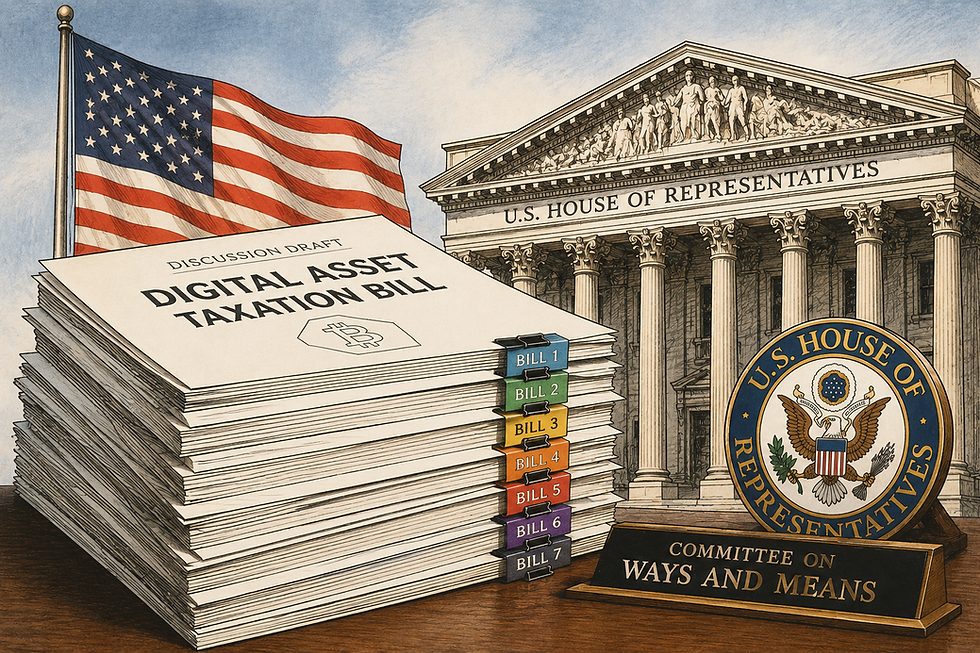
The US House Ways and Means Committee, the body that writes American tax law, held a full legislative hearing on digital asset taxation on 9 June 2026. It was the committee's first such hearing in years, and it came with seven discussion drafts already circulating. Chairman Jason Smith framed the stakes plainly, arguing that America needs clear tax rules to stay, in his words, the digital asset capital of the world.
The drafts try to fix problems that have nagged at the sector since the IRS first classified cryptoassets as property back in 2014.
One would create a de minimis exemption, removing the need to report tiny transactions. A related draft exempts network gas fees under ten dollars, capped at five thousand transactions a year, which is aimed squarely at the absurdity of logging a taxable event every time someone moves a few pounds of tokens. Another tackles the double taxation of mining and staking, where proceeds are currently taxed both when received and again when sold.
A draft from Representative Jodey Arrington would extend established anti-abuse rules, including wash sale provisions, so that digital asset investors are treated like investors in any other asset. A final proposal opens a two year voluntary disclosure window, letting holders self report past unreported income without facing future criminal liability.
None of this is law yet. This was a discussion hearing, not a markup or a floor vote, and the questions from lawmakers made clear the package is still a work in progress. There was no sign of settled bipartisan agreement. The path to enactment still runs through committee markup, a House vote, the Senate, and a presidential signature, and any of those stages could reshape or stall the bills.
Why this matters from a UK desk
Tax is not the glamorous end of digital asset policy. It is, however, one of the quiet forces that decides where capital and companies choose to sit. A founder tokenising equity, a fund holding digital securities, or a platform settling onchain all care a great deal about whether the tax treatment is predictable. Uncertainty is itself a cost, and it tends to push activity toward whichever jurisdiction removes it first.
That is the real signal here. The United States is treating tax clarity as a competitiveness lever, not just an administrative tidy up. The framing is explicit: clear rules to attract and keep digital asset activity on American soil.
For the UK, which has been building its own architecture through the FCA and Bank of England joint vision on tokenisation and the Digital Securities Sandbox, the tax question is the less discussed companion to all that market structure work. Getting the trading and settlement rules right matters. So does making sure the tax treatment of tokenised assets and onchain securities does not quietly send issuers elsewhere.
The detail of seven American draft bills will not survive contact with the legislative process unchanged. The direction of travel is the part worth marking. Major economies are now competing to be the cleanest, clearest place to build with digital assets, and tax is becoming part of that contest rather than an afterthought to it.
Key takeaways
The House Ways and Means Committee held its first digital asset tax hearing in years on 9 June 2026, with seven discussion drafts on the table.
Proposals include a de minimis exemption, relief for small transactions and gas fees, a fix for double taxed mining and staking, extended anti-abuse rules, and a voluntary disclosure window.
Nothing is enacted. This was a discussion hearing, lawmakers raised real concerns, and bipartisan agreement is not yet in place.
The wider signal is that the US now treats tax clarity as a tool to compete for digital asset activity, a point UK policymakers building their own tokenisation framework will be watching.
Sources: Crypto Council for Innovation, Ways and Means hearing wrap, US House Ways and Means Committee press releases; CoinDesk policy coverage.
What happened next
The discussion drafts did not stay drafts for long. On 14 September 2026 Chairman Jason Smith released the Digital Asset Tax Certainty Act (H.R. 10357), a 114 page bill that brought the June proposals together into a single package. The committee marked it up on 16 September and approved it by 38 votes to 5.
The bill differs from the June drafts in places. The fee exception covers network and transaction fees of 10 dollars or less paid in crypto, starting in 2028. Mining and staking income would generally be taxed as ordinary income, and an earlier option to defer tax on newly minted assets was dropped. Wash sale rules would apply to traded digital assets, with a 30 day window either side of a sale. Qualifying crypto lending would not count as a sale, and Treasury would have 12 months from enactment to set up a voluntary disclosure programme. The bill also deals with small deviations from the peg for qualifying US dollar stablecoins.
The bill now goes to the full House, which is in recess until after the November elections. On 1 October Senator Cynthia Lummis said she would be surprised if any digital asset tax measure passed in the lame duck session, citing reluctance on the Senate Finance Committee to reopen the tax code.
What it means for UK founders
The UK has moved first on reporting rather than relief. Under the OECD Cryptoasset Reporting Framework, UK reporting cryptoasset service providers have had to carry out due diligence on their customers since 1 January 2026, with annual reporting to HMRC that covers UK resident users as well as residents of listed countries. Any UK platform that holds or transfers tokens for customers needs to check whether it falls within that definition.
For UK founders with US users, the House bill would change what transaction data those users need. A wash sale rule and a fee exception both depend on accurate dates, values and asset matching, so platforms may need to export richer records. Founders issuing tokenised equity or offering staking to UK users should not assume a US relief has a UK equivalent, and may want to take professional advice on both regimes.
Key facts at a glance
9 June 2026: Ways and Means hearing on seven discussion drafts.
14 September 2026: Digital Asset Tax Certainty Act (H.R. 10357) released, 114 pages.
16 September 2026: committee approves the bill by 38 votes to 5.
Fee exception: 10 dollars or less per qualifying fee, from 2028.
Wash sale window: 30 days before or after a sale.
Next stage: a full House vote, not expected before the post election session.
UK: Cryptoasset Reporting Framework due diligence duties began on 1 January 2026.
Further reading
Frequently asked questions
When did the US House Ways and Means Committee hold its digital asset tax hearing?
The House Ways and Means Committee held a full legislative hearing on digital asset taxation on 9 June 2026. It was the committee's first such hearing in years, and seven discussion drafts were already circulating.
What do the seven US digital asset tax draft bills propose?
The drafts include a de minimis exemption for tiny transactions, an exemption for network gas fees under ten dollars capped at five thousand transactions a year, and a fix for the double taxation of mining and staking. Others would extend anti-abuse rules such as wash sale provisions to digital assets and open a two year voluntary disclosure window for past unreported income.
Are the US Ways and Means digital asset tax bills law yet?
No. The 9 June 2026 session was a discussion hearing, not a markup or a floor vote, and there was no sign of settled bipartisan agreement. The bills would still need committee markup, a House vote, Senate passage and a presidential signature.
Why does US digital asset tax policy matter for UK tokenisation businesses?
Predictable tax treatment helps decide where capital and companies choose to sit, and the United States is now treating tax clarity as a competitiveness lever. For the UK, the tax treatment of tokenised assets and onchain securities is the less discussed companion to the market structure work led by the FCA and Bank of England.


Comments