
Founders' Relief excludes too many founders, Startup Coalition says

Startup Coalition, the UK policy group for startup founders, said on 11 November 2026 that the draft rules for Founders' Relief exclude too many of the founders the relief is meant to reward. It is now gathering evidence from founders before HM Treasury's technical consultation closes on 30 November.
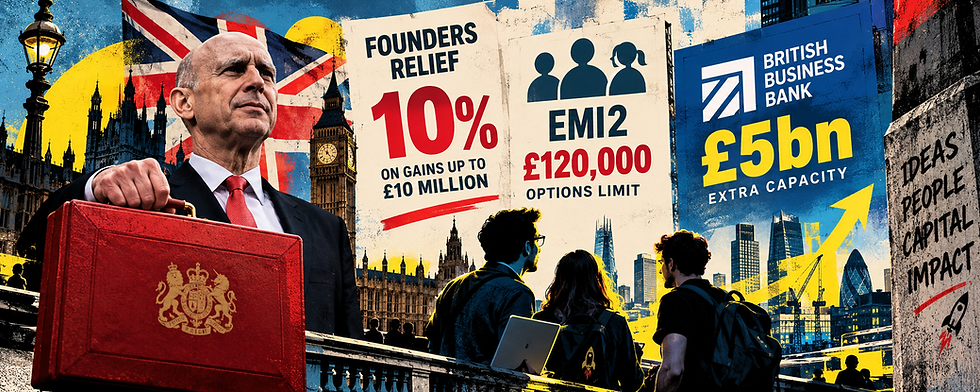
Capital gains tax is paid on the profit made when shares are sold. Founders' Relief would cut that rate to 10 per cent on up to £10 million of lifetime gains for sales from 6 April 2027, against 24 per cent at the higher rate today. For a founder, the rate at exit decides how much of years of work is kept, so what counts is who qualifies.

Who would qualify for Founders' Relief
The founder must have held at least 25 per cent of the ordinary shares when the company started trading, kept them for five years and been UK resident for five years. In the year before the sale, the company needs turnover of at least £10 million and at least 15 full-time employees on 35 hours a week or more.
It must also pass two of three tests: 25 per cent a year compound growth in turnover over three consecutive years from a base of at least £10 million, the same growth in headcount from a base of 15, or £1.5 million of research and development spending in the three years before the sale. Trades excluded under the Enterprise Investment Scheme (EIS) would be excluded here too.
In practice, a company that passes the turnover test has grown from at least £10 million to about £19.5 million in three years. That describes a scale-up, not most companies founders sell. The Budget 2026 summary sets out the wider package.
What Startup Coalition objects to
Startup Coalition welcomes the idea of a relief aimed at founders and puts its value at up to £1.4 million per founder against the standard rate. Its objections are to the detail: the 25 per cent holding required from day one, the size thresholds, and the risk that many fintech and legaltech companies fall inside the excluded activities.
Its sharpest point is the funding. The relief is paid for by cutting Business Asset Disposal Relief (BADR), the existing relief most founders who sell can use today. It is asking founders to complete a five minute survey run with Beauhurst, which closes on 17 November, and to share their own eligibility cases.
What the Business Asset Disposal Relief cut costs
From April 2027 the BADR lifetime limit falls from £1 million to £500,000, with BADR charged at 18 per cent. A founder who uses the full allowance and does not qualify for Founders' Relief now pays 24 per cent instead of 18 per cent on £500,000 of gains, an extra £30,000.
Take a founder with a £3 million gain who misses the tests. Under the current limit the bill is £660,000: £180,000 on the first £1 million and £480,000 on the rest. Under the new limit it is £690,000. Qualifying founders gain up to £1.4 million each; the rest pay more. The case for the design is that a narrow relief costs less and may survive future Budgets. The case against is that it rewards founders only once they have succeeded at scale.
Dates for founders and their advisers
The Startup Coalition survey closes on 17 November. Responses to HM Treasury go to EnterpriseTax@hmtreasury.gov.uk by 30 November, ahead of legislation in Finance Bill 2026/27 and a start date of 6 April 2027.
The 25 per cent test looks back to when the company started trading, so a clean record of who held what from day one matters. A tokenised or digital cap table is one way to keep that history. Staff share schemes are covered in the post on the CSOP limit doubling, and investor reliefs in the SEIS and EIS Budget preview.
Key takeaways
Startup Coalition said on 11 November 2026 that the draft Founders' Relief rules exclude too many founders.
Founders' Relief would tax up to £10 million of lifetime gains at 10 per cent for sales from 6 April 2027, if the founder and company pass strict tests.
The company needs £10 million turnover, 15 full-time staff and two of three growth or research tests in the run up to a sale.
Cutting the BADR limit to £500,000 costs a founder who misses the tests up to £30,000 more tax.
HM Treasury's consultation closes at 11.59pm on 30 November 2026; the Startup Coalition survey closes on 17 November.
References
HM Treasury, Founders' Relief: technical consultation, 28 October 2026
Startup Coalition, Founders' Relief: what it gets wrong and why it needs to change, 11 November 2026
Ross Martin, Government consults on the detail of Founders' Relief, 5 November 2026
Forsters, Budget 2026: new CGT Founders' Relief and changes to Business Asset Disposal Relief, 28 October 2026
This is general information, not legal, tax or investment advice. The figures above are illustrations at current rates and the rules may change after the consultation.


Comments